Statement of Edward Byrne, Archbishop of Dublin. Archive of the Month – May 2010
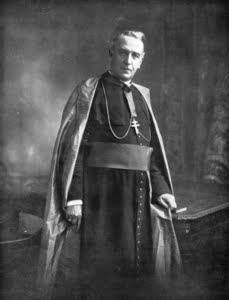
In 1934 the Hospital Commission suggested the amalgamation of the National Children's Hospital and Saint Ultan's Hospital to form a joint hospital providing care to infants and children up to the age of sixteen. The two hospitals agreed in principle, formed a joint committee and selected a site. However, the plan encountered hostility from the Catholic Church and in December 1935 the joint committee asked Edward Byrne, catholic archbishop of Dublin, to outline his objections to the merger.
SU/4/4 - Statement of His Grace, the Archbishop of Dublin, to members of the deputation of the Committee of St. Ultan's Hospital, 20 December 1935
In the statement Byrne makes clear he 'opposes this amalgamation on religious ground solely'. For the Catholic Church hospitals in Ireland were either Catholic or Protestant, as neither Saint Ultan's or the National Children's Hospital were under church control they were seen as being Protestant, and in an amalgamated hospital the 'the faith of Catholic children (who will be 99% of the total treated) would not be safe. The faith of Catholic children is of more importance in the eyes of the Catholic Church than any other thing in the world'.
As well as the perceived danger to the faith of Catholic children posed by the new hospital, Byrne raises two further areas of concern in relation to the new hospital;
'A Children's hospital catering for children from infancy to 16 years is concerned with many serious and delicate problems of puberty and the pre-adolescent stage. The danger of naturalistic and wrong teaching on sex instruction or adolescent problems is a powerful argument for retaining the custody of children in Catholic hands … Again contraceptive practices are recommended by many non-Catholic doctors.'
'There are other considerations which prevent the proposal of amalgamation from being considered as an isolated problem. There is a widespread attack on Catholic morals through the medium of Medicine. Signs of this are not wanting in Ireland. In the Irish Times of November 16th last, Professor Moorhead is reported as having said in Trinity College regarding habitual offenders and mental cases, "I feel strongly that such persons should be sterilised.'
Although Byrne's concerns may seem extreme they need to be seen in the content of the time. Not only was Professor Moorhead talking about the sterilising of so called 'mental cases' but the Nazi regime in Germany was introducing the enforced sterilisation of those considered mentally of physically weak, as part of their Eugenics programme. During the 1930s there was an active Marie Stopes Clinic in Belfast which offered contraceptive advice, and in Dublin the Smyly Homes, which catered for Protestant orphans, were accused on proselytising. It is against this background that this Byrne's statement needs to be seen.
[1]
Saint Ultan's responded to Byrne with a clear statement refuting his accusations and offering assurances that neither hospital had in the past, or would in the future, offer advice on birth control, advocate sterilisation or promote Protestantism. The statement goes to some lengths to show that neither hospital was under Protestant control, with both Protestant and Catholic doctors, and a predominance of Catholic nurses, including the matrons, who have the most regular contact with the patients and by extension the most influence. They also stated the Byrne would be asked to appoint the Catholic Chaplin to the new hospital.
The arguments of Lynn and the Saint Ultan's board were to come to no avail, the power of the Catholic Church in the Irish Free State was such that their opposition was insurmountable and the proposed merger of the two hospitals never took place. The Catholic Church had place the faith of Catholic children over their health, and it was another twenty years before a new children's hospital was opened in Dublin, under the care of the Catholic church and with the Archbishop of Dublin as its director. Ó hÓgartaigh argues that the whole episode needs to be seen in the 'context of the struggle to shape the institutional ideology of the emerging Irish Free State. The Catholic Church's control of health and education was difficult to challenge. Their opposition to new hospitals and schools which would not be under their control was fortified by the conservatism of State Officials.'[2]
[1] Margaret Ó hÓgartaigh, Kathleen Lynn. Irishwoman, Patriot, Doctor (Irish Academic Press, 2006), pp.100-102.
[2] Margaret Ó hÓgartaigh, Kathleen Lynn. Irishwoman, Patriot, Doctor (Irish Academic Press, 2006), pp.104-105.